

Subtraction is Addition | 100th post!
Invisible but important

Welcome to new readers and thanks for reading! I am grateful to Max Falkowitz for recommending my newsletter. Max is a tea writer and editor for publications, including the NYT. His newsletter, Leafhopper, is a delightful and thoughtful read on all things tea, including my recent favorite on the tea mountains of Taiwan.
72 Seasons of Tea: Peck Gee Chua writes from Japan about the spiritual side of tea, incorporating nature, Zen philosophy, and Taoism into her entries. This aspect of tea discourse doesn’t come naturally to me, so I’m grateful to read a more eloquent expert on the subject.
— The tea newsletters I read, by Max Falkowitz
Through subtraction, space expands
For my 100th post on Substack, I’d like to share this short reflective piece.
Here’s the truth of meditation: It gets easy if you get easy. It gets simple when you get simple. Outside of that, there’s no secret, no short cut. — Adyashanti
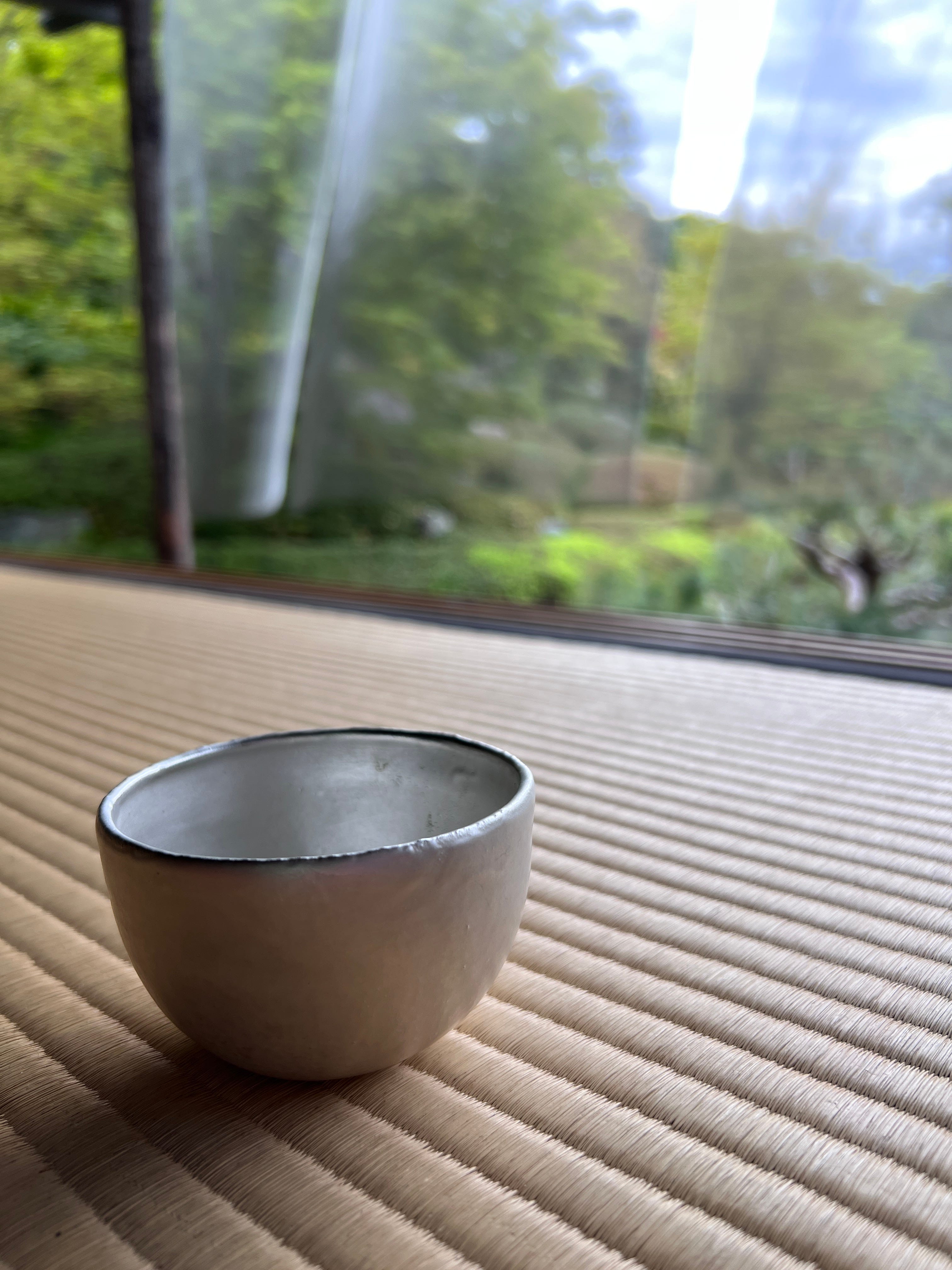
I love meditating in the deep of dawn. In Spring, early mornings in Kyoto carry a certain tenderness - a sense of loosening into life. The chorus of birds fills the air with a spirit of aliveness. The cool air, gentle. The deep scent of incense and the moist dewy air, like two invisible energies meeting each other.
Still, there are many days, when I can’t seem to settle into either the outer senses or the sensations in my body, unlike in 2024 when my calendar wasn’t as packed — but I sit anyway.
Like the regular cleaning a house requires, an always-on life needs consistent subtraction, an inner alignment. It is a continuous practice, to keep pockets of open space in the day, without joining in the rush, allowing room to breathe for just a little more.
In the Zhuangzi, there is a line: 虚室生白 when the room is empty, light enters. When the mind is free from attachment, it becomes clear. When a person’s mind is given space to flow freely, without gripping, clarity arises - not through forceful effort, but through letting go.
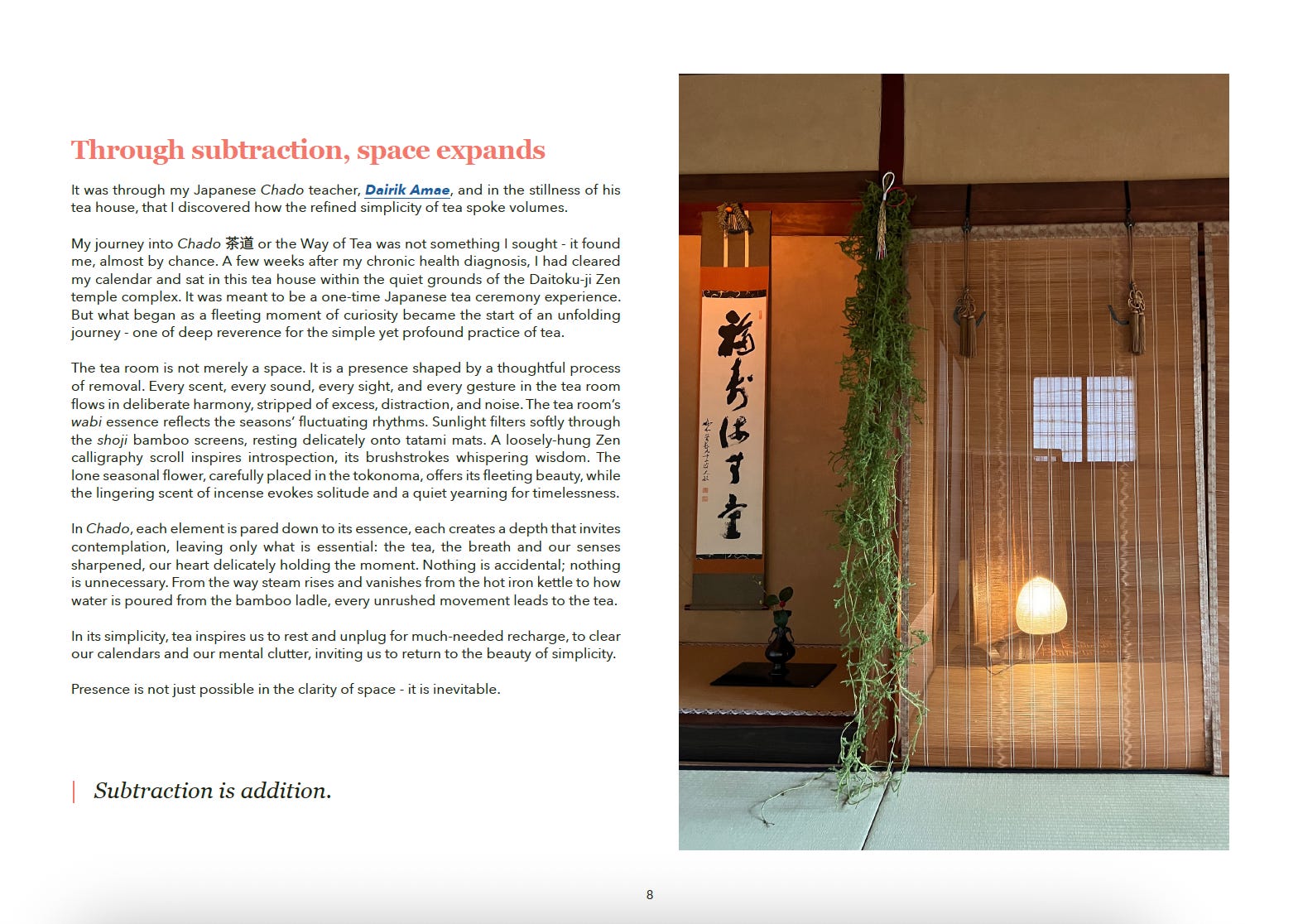
Dairik Amae, my teacher who first introduced me to chado 茶道, the Japanese tea ceremony, and to the spiritual dimensions of tea, once told me that the most important element in a Japanese tea room is the kensui 建水: a vessel that receives waste water during tea preparation.
He told me, less is more.
To make space, something must be emptied. To refine, we need to let somethings go. But before any of that, there must first be acceptance.
When scarcity reveals
Japanese tea rooms operates on the premise of subtraction and paradox.
As I’ve shared in my previous posts on tea, one of the core philosophies in tea is Zen Buddhism — also known as Chan Buddhism, originally from China.
Put simply, Zen is a fusion of Mahayana Buddhism with the influence of Taoism - both with strong elements of independence thinking. As described in “The Book of Tea” by Okakura Kakuzo, “Zen was opposed to the precepts of orthodox Buddhism even as Taoism was opposed to Confucianism.”
Zen is playful, multidimensional, with both the practical and disciplined side, as well as the artistic and aesthetic form of being in the world.
“Zen, like Taoism, held that in great relation of things there was no distinction of small and great, an atom possessing equal possibilities with the universe… Truth can be reached only through the comprehension of opposites.”
Japanese tea rooms are intentionally kept empty, sparsely furnished. Movements done in slow but steady, graceful motions. Primarily an otherworldly encounter of thoroughly experiencing the host-guest relationship, sitting in silence, of emptying — a reset to recenter on what it means to be a human.
The Japanese tea ceremony, refined in an era of chaos, when it’s unknown to the samurai if they will live to see the very next moment (See essay, Embracing the Unexpected).
In crisis, the familiar falls apart. What once felt urgent begins to fall away and we are drawn to what truly matters. A rare opportunity to discard, to subtract, to zoom into the bare essentials.
Like an iceberg, the deeper nuances and subtleties take time to reveal themselves.
Crisis strips away the nonessential. In that opening, what is usually invisible - important but not urgent - can begin to surface. Not because it was absent before but because there is finally space to see.
And in the stillness of our own heart, we come to recognize what matters most.
On Tea, Zen, Taoism
Beauty of Tea - Dairik Amae in Conversations Mostly from Kyoto
Tea, Zen, and Rediscovering Our Natural Self - Naoko Iwasaki in Conversations Mostly from Kyoto
Taoism and Tea: Applications of Eastern Philosophy in Times of Crisis - with Yuxuan Francis Liu, 2nd Prize, Philosophy and Beyond Essay Contest
Embracing the Unexpected - My essay on tea, zen and life on Musubi Academy
On the Invisible but Important
Rajesh Kasturirangan - On the invisible metabolism of civilization: Helium, metformin, LPG/firewood
Yanlong Huo - Hormuz seen through a nuanced lens
Kriangsak T., PhD - AI and the unpaid, invisible value of caregiving and life-making
Thank you. May your posts keep flowing effortlessly as a river to the sea.
Congratulations on 100 posts! Agree completely on subtraction! Sometimes when we take things away, it can be surprising how much time opens up!