



If you enjoy my writings, please consider a paid subscription or donating a cup of tea.
Today, we enter 大寒 (Daikan or Greater Cold) — the coldest and the final of the 24 solar terms, introduced from China to Japan over 1,200 years ago during the Nara Period through agricultural observations.
From Lesser Cold to Greater Cold, flowers in Japanese tea rooms transform, mirroring the rhythms of the seasons — from Shuixian and Wabisuke tsubaki (Camellia Japonica) to the delicate, yellow buds of Robai 蝋梅 (wintersweet).
Zhuangzi《莊子》, a foundational text in Taoism, opens its Inner Chapter 1 with Free and Easy Wandering (逍遙遊), not with philosophical analysis, but through myths, parables, and improbable imaginative transformations — the adult equivalent of Roald Dahl or Enid Blyton — in beautiful, poetic language.
This text does not speak in the language of logic, but through imagination to reengage our senses, to stir our emotions, to draw us into solitary conversations with the larger worlds beyond the limits of reason.
Carrying us beyond our relative world, so often confined by the hardware and software of the limited human lens — to cross thresholds, to wander into a vastness that is quiet, yet wondrously alive beyond time and space.
Ushering us back to becoming ourselves, once again. To the person who once dream of becoming.
In the winters of our lives, how do we continue to bloom, to become, to find inner freedom? Zhuangzi reminds us that the heart can widen as the spirit learns to roam, even in the depths of winter.
Tea and Zhuangzi’s Xiaoyaoyou 《逍遙遊》
The following short essay on Tea and Zhuangzi is part of my 2024-25 photo essay collection (38 pages) for paid subscribers.
An unpublished essay exploring tea and a classical text in dialogue on the meaning of inner freedom – a text whose spirit of freedom, naturalness, and harmony has long shaped the Way of Tea in Japan and inspired countless poets and sages, from Tao Yuan Ming to Bashō and Baisao.
Tea 茶
Tea has been a constant in my life as a Southeast Asian with Chinese roots. Growing up, I drank chrysanthemum, oolong, pu’er, and liu bao tea, whenever we ate out at Chinese restaurants – from fancier fine dining to humble zafan dian (杂饭店, “common people’s mixed rice shop”).
But it’s only from last year when I got sick that I truly noticed tea. Intuitively, I sense that there is a reason. And it’s from this seed that I keep returning to tea here in Kyoto.
Tea teaches me the meaning of freeing the mind, by letting go of all that cloud perception. There are at least 2,000 teas spanning six categories of tea. From ceremonial matcha to culinary varieties, many of which have no official grades in Japan, modern tea has been simplified into neat assumptions for our convenience, from high-end to everyday brews.
Tea comes in many forms, yet through it we can practice seeing for what it truly is – arinomama (ありのまま) or, in a more philosophical sense, arugamama (あるがまま), seeing reality in its natural state, a Japanese sensibility influenced by Zen.
In harmony with the Taoist ideals of wuwei ziran (無為自然), tea invites us to experience life as it is, aligning with the natural unfolding of things: simple, effortless yet intentional, and fully present in each moment. Engaged in life, yet unforced.
To monks, tea is a disciplined, ritualized path of meditation; and to farmers, tea is woven into their everyday life – simple, practical, and comforting. High mountain tea is not inherently better than those from lower elevations; nor is soft water, despite generally prized, always ideal for bringing out the best in heavily roasted teas.
Tea that fetches the highest price is not always the best. Tea brewed in the finest ware, in the grandest hotels, is not necessarily the most delicious. Tea made in traditional tea rooms is not necessarily the purest. Matcha is not always the healthiest based on your body constitution.
Life, like tea, is not black and white but layered in subtle gradations. To truly see, we can only shift our perspective.
Zhuangzi’s Xiaoyaoyou《逍遙遊》
Tea embodies a spectrum of philosophies – Zen, Mahayana Buddhism, the principles of Yin-Yang and the Five Elements, Confucianism, Shintoism, Taoism, and Western influences.
Taoism is certainly one that speaks deeply to my heart in its quiet, gentle, and natural ways. The Taoist spirit of xiaoyao 逍遥, expressed in Zhuangzi, echoes through Japanese chado and, even more so, Chinese and Taiwanese chadao (茶道), sharing the same written characters across all three traditions. Zhuangzi’s writings are poetic and beautiful, filled with dreamlike imagination that blurs the boundary between waking and dreaming – as in his famous Butterfly Dream.
Free and Easy Wandering 《逍遙遊》, the opening chapter of the book Zhuangzi, introduces his conception of the dao (道). The Way is not rigid nor a fixed path, but a reflection of life’s natural spontaneity – unbounded and ever shifting. As we deepen our practice to “freely wander about” and embrace a broader perspective, we come to find ourselves truly on our Way.
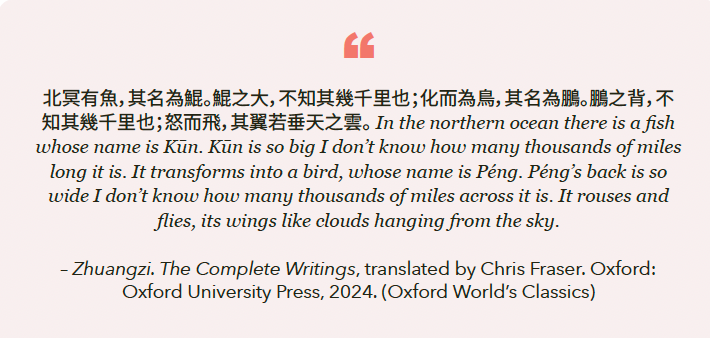
Zhuangzi’s use of language was masterful, despite the fact that he calls into question the utility of words. Kūn was laughed at by the little birds – what seems impossible from one perspective may be entirely natural for another. That is a primary reason I have been drawn to Zhuangzi and Taoism. Taoism does not assert that its perspective or way of life is the best or that its judgment can be right; instead, it recognizes the narrowness of any single view and the limits of the person. — Yuxuan Francis Liu. Click here for original Chinese texts.
See True Meaning of 独尊 (Dokusonsha) by Takahiro Mitsui - “That very misfortune becomes the turning point that invites great opportunity.”
The opening chapter contains multiple stories, beginning with Zhuangzi’s accounts of a mythical, unimaginably massive fish called kūn (鯤). This enormous fish undergoes a remarkable transformation into a gigantic bird, the péng (鵬), whose wings span so wide they obscure the sky like clouds. The story evokes the boundless possibilities of life and the holistic vastness of perspectives, reminding us of the freedom in choosing to rise beyond our ordinary limitations.
While there are many interpretations, here are some of my favorite passages from the first part of chapter one, reflecting how I currently see the meaning of freeing our minds through the lens of tea:
How can a fish transform into a bird? This calls for us to reconsider the importance of freeing and broadening our perspectives, rather than being limited by narrow human viewpoints. Despite our limitations — often self-imposed or unconsciously conditioned as we grew up, or through external forces — we can learn to expand our vision and embrace the vast possibilities life offers. There is always a scope for us to transcend.
怒而飛,其翼若垂天之雲。It rouses and flies, its wings like clouds hanging from the sky. Though our knowledge may be limited, our potential is as vast and deep as an unending well – truly limitless, if only we care to accept and acknowledge our limitations, while learning how to wisely draw from them, embracing both our constraints and our capacities.
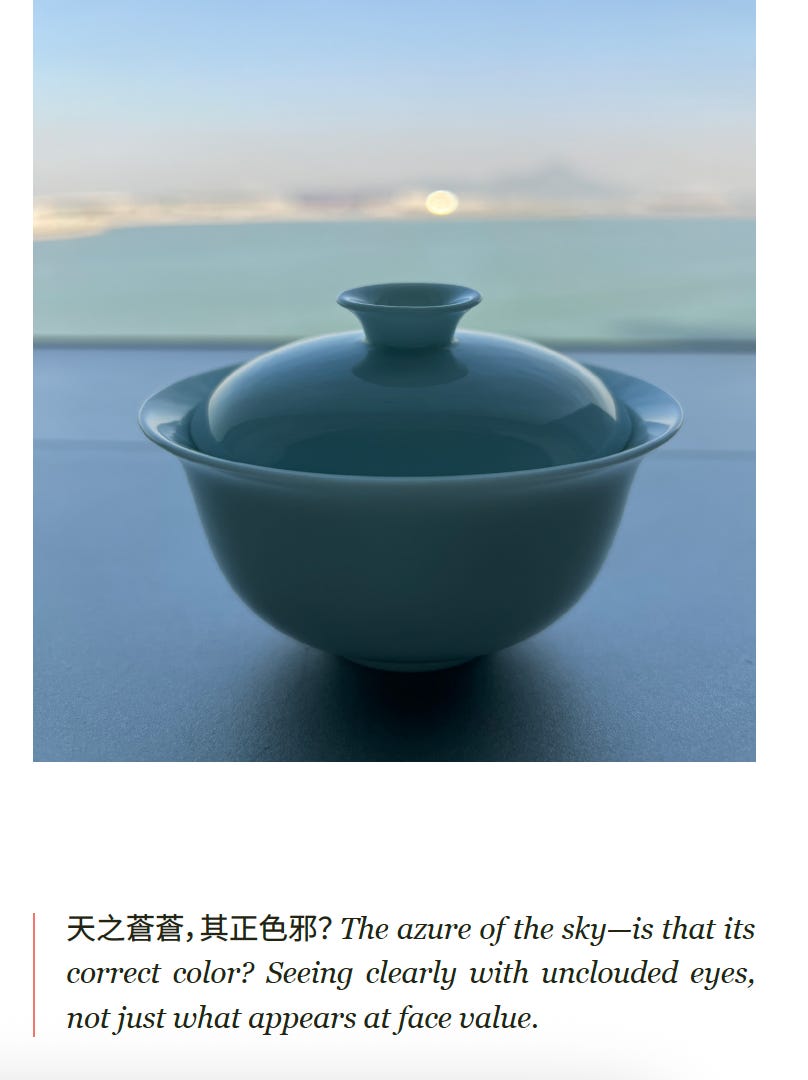
天之蒼蒼,其正色邪?The azure (blue) of the sky—is that its correct color? Or is it just that it’s far off and nowhere comes to an end? Through science, we understand that the sky appears blue to us, yet it is not inherently blue. This observation points to the importance of seeing clearly, of perceiving nature and the cosmos with insight and curious attentiveness, rather than taking appearance at face value.
楚之南有冥靈者,以五百歲為春,五百歲為秋;上古有大椿者,以八千歲為春,八千歲為秋。 South of Chǔ there is a sacred tortoise for whom five hundred years makes spring, five hundred years autumn. In antiquity there was the great Chūn tree, for which eight thousand years made spring, eight thousand years autumn. We live our lives in human clock time - seconds, hours, days, and deadlines - but this is only a narrow framework. When in reality, the concept of time unfolding in rhythm is beyond our grasp. Creatures have evolved over millions of years, mountains have risen and eroded, stars born and died, all these dimensions exceed our awareness. The cosmos itself moves by its own unmeasurable clock – reminding us that our notion of time is but a fleeting ripple on a vast, immense flow.
故曰:至人無己,神人無功,聖人無名。So it’s said: The ultimate person has no self; the spirit-person has no achievements; the sage has no name. Self, achievements, and reputation are all externally dependent, with fixed values generally bound by the society. The wandering person does not cling to them, but lets them go. Whether our influence is great or small, these are only surface-level impressions. True freedom comes from trusting ourselves, grounding our sense of worth internally rather than being swayed entirely by external factors. Here lies a timeless lesson: to cultivate confidence in who we are, while accepting and finding contentment in our inherent limitations.
Zhuangzi’s idea of free and easy wandering is one centering on inner and spiritual freedom. Being a fish or a bird is neither better nor worse, as these distinctions are human-made, artificial, rigid with shortcut assumptions based on our reliance on the familiar. True strength lies in a sense of value that comes from within, even humbly embracing limits, rather than relying on the world’s approval or criticism.
What holds us back are our assumptions, our preconceived and fixed thoughts. It is only by freeing ourselves – releasing familiar, rigid patterns of thinking – that we can truly wander free and easily.
Free and easy wandering is not just a superficial luxury tied to wealth and resources, it is a state of inner leisure, a freedom of mind, available to all who choose to embrace it.
A fish so vast it becomes a bird. Here, such freedom, is not a fantasy for escape from winter, but a parable for inner freedom, to release from the smallness of perspective. What binds us is not hardship, but our mind’s habit of measuring itself against narrow skies. — A quote I rephrased with the help of AI
Peckgee, I genuinely think this piece is worth reading and rereading. Many gems in it, great for inspiration, for rethinking how we think. A wonderful invitation to "the person who once dream of becoming."
Beautiful and profound, Peck Gee. Thank you.