


P.S. I’m reducing the frequency of my posts, leaving relevant links throughout this piece as an archival collection of over 100 posts for you to explore at your own pace. Thank you for supporting 72 Seasons of Tea!
On to my 2nd act: Spaciousness
My husband shared an analogy with me, that I’m like a pencil.
For things that deeply interest me, I have almost laser-like focus. But without realizing, I get pushed to the edge, giving too much of myself along the way.
Like a pencil sharpened, over and over again, until there is little left.
Twice, my body has broken down. The first was in 2024, with a sudden diabetes diagnosis.
Now, I’m entering another difficult season, one that feels even more demanding than the one two years ago.
Relentless on the health front, with old diagnoses persisting and new ones emerging. From clinics to the hospital, navigating language barrier, I find myself collecting health diagnoses I never set out to have.
Twice, my body has broken down from doing what I love.
Twice, I felt as though life was cruising just before my body interrupt it with sharp pain.
Once for work, when I was intensely immersed in climate change and early childhood. And now again in learning, trying to do them all at once: writing, Japanese intensive course, tea, philosophy and spirituality, alongside cooking, parenting and household life.
Unintentionally, I was trying to rush because I know that life is all too precious. And I really do love to learn.
Now, it feels a bit of an overdue reckoning, having to say no to many things I love — cutting down and simplifying my life over the past several weeks.
These have been painful, lonely moments of self-reflection and difficult choices.
Why have I continued to give away my precious time so freely, from work to sharing my writing mostly for free?
Why do I find it so difficult to simplify, to subtract from things that are good to do, not necessarily things I must do?
From classes to courses, while seemingly meaningful and important, have I been overdoing it and becoming distracted?
Is our busy-ness a disguise for avoiding the most important problems we must face in life?
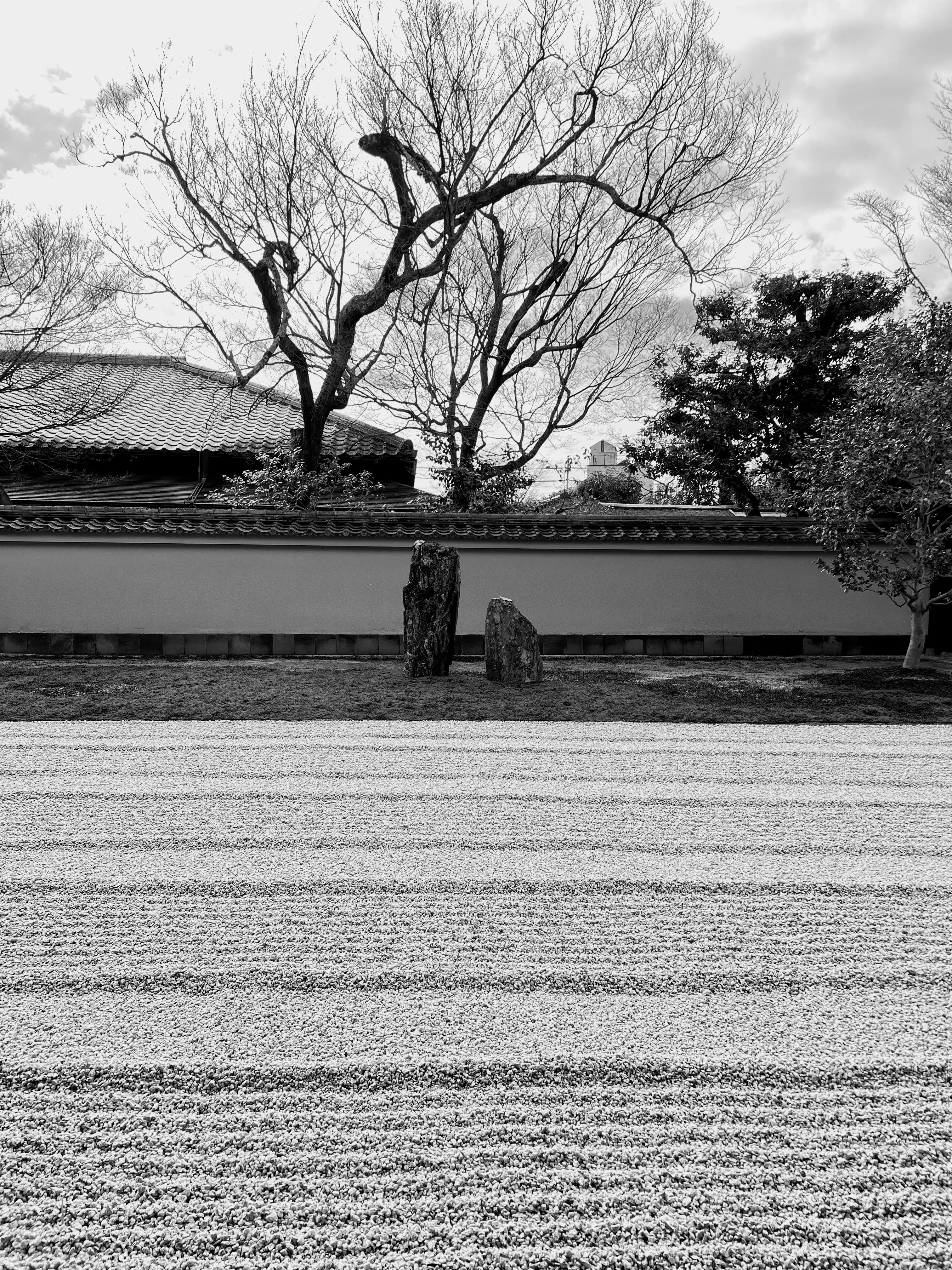
物極必反 Reversal in Extremes
Wuji bifan is a Chinese concept tied to the Dao De Jing (道德经), reflecting the balance of yin and yang — that apparent “opposites” are in fact complementary. They coexist and transform into one another.
Change is life, and a part of nature’s ebb and flow. And no extremes last forever. When yin or yang reaches its peak, it starts to decline and transform into the other.
Whether you are at the height of success, triumph can begin to turn when taken to an extreme. In the same vein, within despair lie the seeds of transformation.
In times of adversity, there is hope.
Perhaps this is why Taoism so often points to the power of not maximizing, as excess can ultimately undermine us.
Where there are extremes, reversal begins.
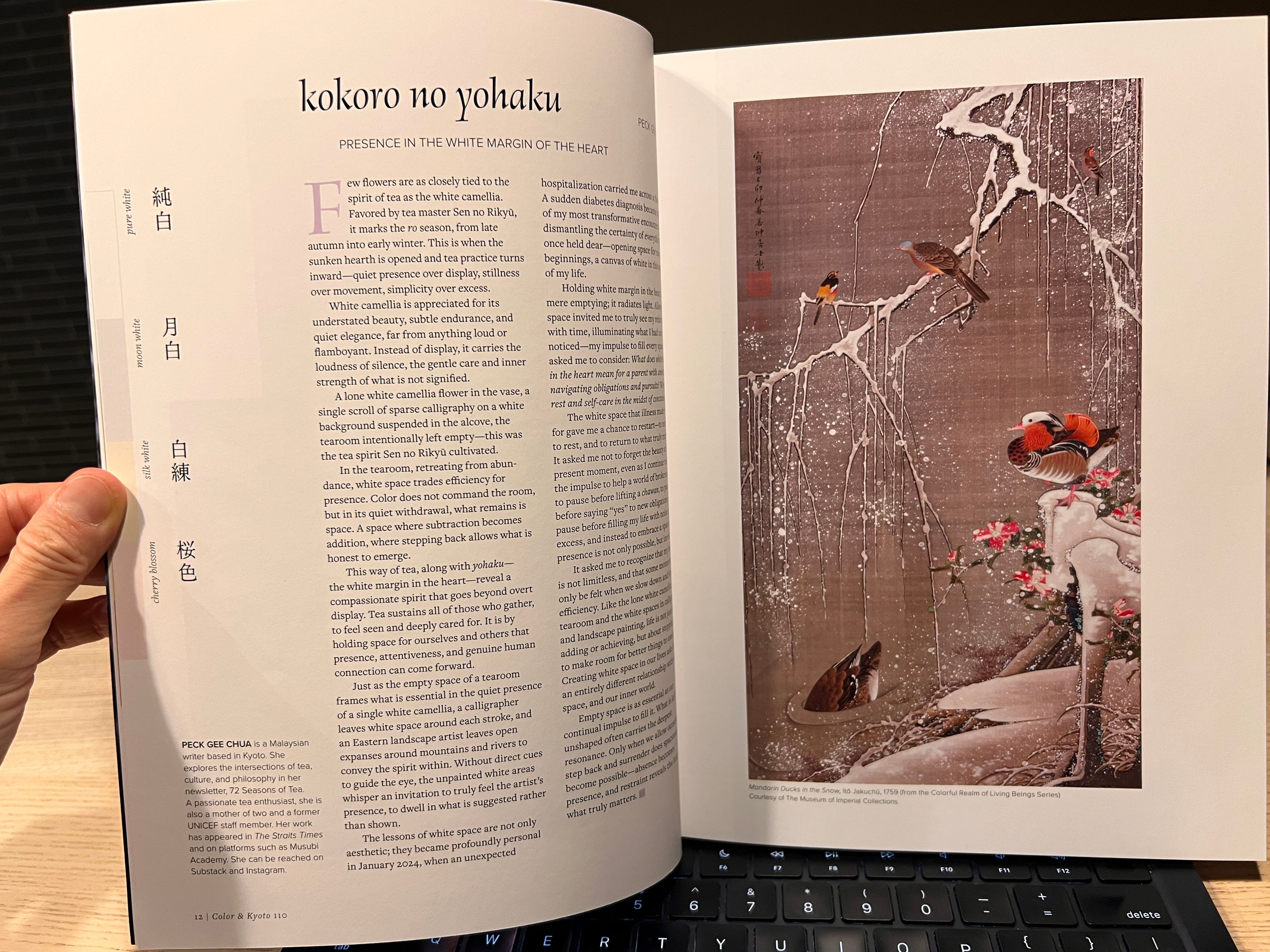
Retreating from abundance, white space trades efficiency for presence. In its quiet withdrawal, what remains is space. A space where subtraction becomes addition, where stepping back allows what is honest to emerge.
~ Living my own words in kokoro no yohaku 心の余白
Presence in the White Margin of the Heart
📒 Read: My recent publication in Kyoto Journal, Issue #110 (2026)
Loudness of Silence
Empty space is as essential as our continual impulse to fill it.
Full Archive
For key publications, see welcome page.
Explore the full archive of 72 Seasons of Tea across 3 primary series and various themes:
Zen-Taoist Living. 茶禪人生 - A series exploring tea’s Eastern spiritual roots through my ongoing journey of learning the Way of Tea since 2024. An invitation to look back to look forward, to find meaning by seeing deeply, and to return to a simpler way of life.
Conversations Mostly from Kyoto. A conversation series with independent-spirited creatives living unconventional lives who inspire me. From Kyoto and beyond, we explore beauty in the ordinary and the unexpected through wide-ranging conversations on nature, culture, spirituality (now with 11 individuals).
Poetry & Roots. Tracing my Fujian roots through the lens of tea and poetry - a journey through memory and place, from Kyoto to China and Malaysia.
Books. Books I enjoy on the questions of life, meaning, and time, from Small is Beautiful to The Importance of Living by Lin Yutang.
If you enjoy my writings, please consider a paid subscription or donating a cup of tea.
The idea that opposites are in relation to each other and structure our world goes against the modern view that there are no limits in this infinite universe. So I think we are all facing what you are dealing with to some degree as modern people. It often takes some kind of suffering to shift away from a life of accumulation and more. I feel for you knowing how difficult the shift has been for me. Keep faith in your deepest awareness.
Can relate so much to this cycle — having an experience involving illness/death (reminders of the brevity of life) that spurs motivation to squeeze more out of life (seizing the day, so to speak, now that the sense of the end is so sharp) only to have the very act of squeezing/seizing at best block our ability to enjoy our true nature in this physical form (as long as we have it) and at worse accelerate the illness/death cycle by destroying ourselves/minds/hearts in the striving.
So often I want to study and read and write and experience all the things—because I love them and they are as easy to fall in love with in Kamakura as in Kyoto. My Daoist teacher likes to remind me "slow is the fastest way" so kudos to you for slowing down. A reminder for all of us to do the same.
Another teacher by another name (Bus Driver) has a couplet of lyrics that comes to mind whenever I notice myself trying to squeeze a bit too much out of life:
"I'm just doing all of my favorite stuff
And I'm doing too much
I may dislocate my rotator cuff"
The song & video for a more (and maybe needed) irreverent take so we don't dislocate our literal and figurative rotator cuffs:
https://www.youtube.com/watch?v=HHM62T8TLHA
Thanks as always PGC — I think I speak for other fans of your work when I say: we'd rather have a slow, healthy and safe you than a fast/ "productive" one that is in danger.